By Advit
15 min read
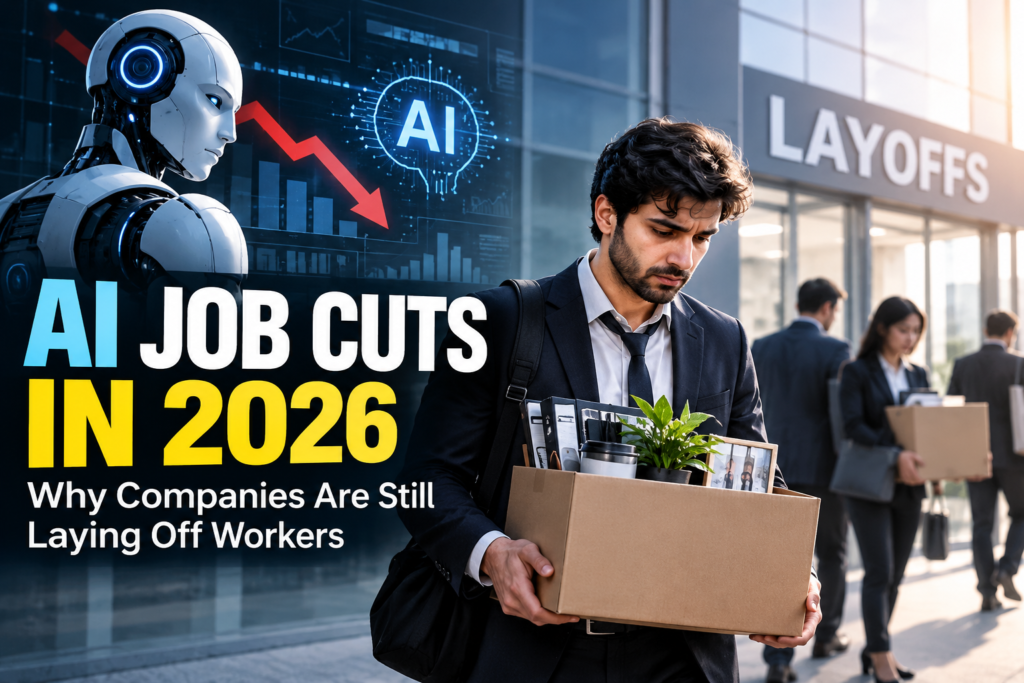
AI Was Supposed to Create Jobs. Why Are Companies Still Cutting Them at the End of 2026?
Artificial intelligence was expected to make work easier, help businesses grow, and create new career opportunities. Companies invested billions of dollars in AI tools, automated systems, and advanced computer technology. Many workers hoped this new technology would open doors to better jobs and help them become more productive.
But as 2026 draws to a close, an uncomfortable question remains: if AI is helping companies do more work in less time, why are so many businesses still cutting jobs?
The answer is not as simple as saying that AI is replacing everyone. Companies are using AI to reduce costs, increase productivity, reorganize teams, and change the way they hire people. Some are replacing specific tasks with automation, while others are cutting jobs because of financial pressure, earlier hiring decisions, or a shift in business priorities.
Research published in 2026 suggests that AI is already changing employment, although the effects vary across industries and groups of workers. A report from the International Labour Organization found that large-scale job displacement remains limited in the available evidence, but younger workers, job quality, and future employment opportunities face important risks.
In this article, we will explore why companies are cutting jobs despite the growth of AI, which workers may face the greatest challenges, and what people can do to prepare for the changing job market.
1. Companies Want More Work From Smaller Teams
One of the biggest reasons behind AI-related job cuts is productivity.
In the past, a company might have needed ten employees to complete a large amount of routine work. Today, AI tools can help a smaller team draft documents, analyze information, write code, answer customer questions, and prepare reports.
This does not mean AI can perform every task independently. Employees still need to check its output, solve unusual problems, and make important decisions. However, when AI helps a team finish routine work faster, management may decide that fewer employees are needed.
For example, imagine a company with 20 employees working in customer support. The company introduces an AI chatbot that can answer common questions about orders, payments, and account settings.
The chatbot handles many basic requests automatically. Human employees continue to manage complaints, complicated problems, and sensitive cases.
The company may decide that it no longer needs the same number of support agents.
This is where the problem begins. The technology creates a productivity benefit for the business, but that benefit does not automatically create new jobs for the employees whose tasks have been reduced.
According to S&P Global’s 2026 research on AI and employment, companies commonly prioritize process efficiency and employee productivity when adopting AI. Reducing headcount is a less frequently stated objective, although employment effects can still become negative as businesses change how they operate.
Source: S&P Global, The AI and Labor Landscape 2026
2. AI Can Reduce Hiring Before It Causes Mass Layoffs
When people discuss AI and unemployment, they often imagine a company announcing that thousands of employees will lose their jobs.
However, a quieter change may be just as important: companies may simply stop hiring as many people as they did before.
Suppose a software company previously hired 50 junior developers every year. After introducing AI coding assistants, experienced developers can complete some tasks more quickly. The company might decide to hire only 25 junior developers in the next hiring cycle.
No existing employee needs to be dismissed for this change to affect the job market. Yet 25 people who might have received job offers could now struggle to find work.
This matters because fewer entry-level positions can make it harder for young people to gain experience. Without that first job, they may find it more difficult to build the skills needed for senior positions later.
A Stanford Digital Economy Lab working paper, revised in August 2026, reported that employment among workers aged 22 to 25 in AI-exposed occupations was below the level its researchers estimated would have occurred if employment had kept pace with less AI-exposed peers. The researchers linked much of the difference to reduced hiring rather than increased separations.
These findings are early indicators, not proof that AI alone caused every employment change. Nevertheless, they highlight why hiring trends deserve as much attention as layoff announcements.
Source: Stanford Digital Economy Lab, Canaries in the Coal Mine?
3. AI Is Also Becoming a Reason to Reduce Business Costs
AI is not the only reason companies cut jobs. Businesses have always reduced their workforce when expenses rise, sales slow down, or their strategies change.
What is different now is that AI gives companies another way to reduce the amount of human work required for certain activities.
Businesses must pay salaries, benefits, training expenses, office costs, and other employment-related expenses. AI software also costs money, but companies may expect it to handle some tasks at a lower cost over time.
Consider an online business that employs a team to write product descriptions, prepare marketing emails, organize customer feedback, and create basic reports.
If AI tools help the existing team handle these tasks more efficiently, management might decide to combine roles instead of hiring additional employees.
The business could then use the money it saves to invest in marketing, infrastructure, product development, or AI services.
However, AI adoption is not always cheaper in practice. Businesses must pay for software, computing resources, data security, integration, maintenance, and human review. Poorly implemented systems can also create errors and additional work.
The financial benefit depends on how well the technology fits the business and whether the savings outweigh the costs.
For workers, the important point is that companies often evaluate jobs according to business needs, not just the quality of an employee’s work.
4. Some Companies Overhired Before AI Became Popular
Another reason for job cuts is the hiring boom that took place in earlier years.
During periods of rapid growth, companies often hire more employees to develop products, expand operations, and compete with other businesses. If growth later slows down, they may discover that their teams are larger than necessary.
Management then looks for ways to reduce costs and simplify the organization.
By 2026, AI has become part of that discussion. Companies may use automation to justify reducing roles that they previously needed to support a larger operation.
Research from Revelio Labs published in August 2026 examined companies that attributed workforce reductions to AI. It found that many had increased their AI-related staffing while reducing other roles, but the patterns were not identical across all companies. Some had also been shrinking their workforces before announcing AI-related cuts.
This suggests that AI can be both a genuine reason for restructuring and a convenient explanation for broader cost-cutting decisions.
A company might genuinely need fewer employees because AI has changed its workflow. Another might be correcting earlier hiring decisions or responding to weaker financial performance.
That is why it is misleading to assume that every job cut announced in 2026 happened because an AI system replaced a human worker.
Source: Revelio Labs, Is AI Just a Scapegoat for Layoffs?
5. Companies Are Moving Money From Employees to AI Infrastructure
Modern AI requires significant investment.
Businesses are spending money on computing power, data centers, specialized chips, cloud services, software development, and the people needed to build and manage these systems.
Some companies believe that investing in AI today will help them compete more effectively in the future. As a result, they may reduce spending in other areas to make room for these investments.
This creates a difficult situation for employees. A company can report strong technology investment while simultaneously reducing the number of people on its payroll.
Recent reporting has described workforce reductions across technology, banking, and other industries as businesses redirect spending toward AI and operational efficiency. Reuters reported on October 22, 2026, that companies including Microsoft and Barclays were among those announcing workforce changes amid growing attention to AI-driven restructuring.
However, not every reduction is directly caused by automation. Companies can also cut jobs because of changing market conditions, organizational restructuring, or a desire to improve profitability.
Source: Reuters, Companies Cutting Jobs as Investments Shift Toward AI
The broader lesson is that investment in new technology does not guarantee an increase in total employment. A business can spend more on technology while spending less on certain categories of labor.
6. Which Jobs Are Most Likely to Change?
AI does not affect every occupation in the same way. The biggest changes often occur when a job includes a large amount of repetitive, predictable, or information-based work.
Some roles may shrink, while others may change significantly or create new opportunities.
Here are several areas where workers should pay attention.
Customer support
AI chatbots can answer frequently asked questions, guide users through basic troubleshooting, and help process routine requests.
Human employees remain important for complex complaints, sensitive situations, and problems that require judgment. However, companies may need fewer people for basic support tasks.
Content writing and digital marketing
AI can generate initial drafts, product descriptions, social media captions, advertising variations, and content outlines.
This can reduce the time needed for basic content production. Writers who can research topics, verify facts, understand audiences, develop original ideas, and edit AI-generated drafts may be better positioned than those who rely only on producing large amounts of generic text.
Software development
AI coding assistants can help developers write code, explain errors, create tests, and document existing projects.
These tools can improve productivity, but they do not remove the need for people who understand system architecture, security, databases, debugging, and real business requirements.
Junior developers may face particular challenges if companies reduce entry-level hiring before creating enough alternative training opportunities.
Data entry and administrative work
Tasks such as sorting information, preparing routine reports, processing forms, and updating records may be increasingly automated.
Employees who can manage workflows, investigate unusual cases, maintain data quality, and improve business processes may have more opportunities to move into higher-value responsibilities.
Graphic design and image editing
AI image generators can create visual concepts, backgrounds, and variations quickly. This can change the economics of basic creative work.
At the same time, businesses still need people who understand branding, visual communication, composition, copyright concerns, and customer requirements.
The common theme is that AI often changes the tasks inside a job before it completely removes the occupation.
7. AI Is Creating Jobs, but Not Always for the Same People
There is another side to this story.
Companies need people who can build AI systems, integrate them into existing software, evaluate their output, protect sensitive information, and help employees use them effectively.
New opportunities can emerge in areas such as:
AI application development
Machine learning engineering
Data engineering and analytics
AI testing and quality assurance
Cybersecurity and privacy
Cloud infrastructure and automation
AI-assisted product development
Technical support for AI systems
However, these new jobs do not automatically replace every job that disappears.
A customer support agent whose role is reduced may not have the technical background required to become an AI engineer. A junior content writer may need additional training to move into content strategy or technical writing.
The location of jobs also matters. New AI positions may appear in different cities, companies, or countries from those where job losses occur.
India offers a useful example of this mixed picture. An August 2026 report by India Today, citing Nomura research, said India had recorded 83,100 AI-related hires compared with 31,921 layoffs and attrition cases linked to AI in the research examined.
Those figures suggest that AI-related hiring can outnumber reported job losses in a market. They do not mean that every affected worker can easily move into a newly created role, or that the figures represent the entire Indian labor market.
Source: India Today, AI Is Creating More Jobs Than It Cuts in India, but There’s a Catch
The real challenge is helping workers gain the skills needed for the jobs that are emerging.
8. What Should Workers Do to Stay Relevant?
Nobody can predict exactly how many jobs AI will change over the next few years. However, workers can take practical steps to prepare for the changes already taking place.
Learn to use AI tools in your current job
You do not need to become an AI researcher to benefit from AI.
A marketer can use AI to analyze customer feedback. A developer can use it to explain errors and create tests. A writer can use it to organize research and improve a first draft.
The goal is to understand how AI can improve your work while learning where human judgment remains essential.
Build skills that go beyond routine tasks
Try to develop skills such as problem-solving, communication, critical thinking, research, project management, and decision-making.
These abilities help you understand what needs to be done, evaluate whether an AI-generated result is correct, and take responsibility for the final outcome.
Create real projects instead of collecting certificates
If you want to work in software development, build a small application. If you want to work in digital marketing, create a campaign and measure its results. If you are interested in AI tools, build a workflow that solves a real problem.
Practical examples help demonstrate that you can apply what you have learned.
Keep learning within your existing field
You do not necessarily need to change careers every time a new AI tool appears.
A web developer can learn AI integration. A content writer can develop stronger SEO research skills. A designer can combine traditional design principles with AI-assisted image editing.
Combining existing expertise with new technology can be more useful than starting from zero in an unrelated field.
Pay attention to hiring trends
Read job descriptions in your industry and identify which skills employers are requesting more often.
Look for changes in entry-level requirements, commonly used tools, and the responsibilities attached to different roles. This can help you choose training that matches real opportunities rather than following every new technology trend.
9. Will AI Eventually Replace Most Human Jobs?
There is no reliable evidence that AI will replace most human jobs by the end of 2026.
Some tasks are becoming easier to automate, and certain occupations may experience lower demand. At the same time, many jobs involve physical activity, human relationships, accountability, complex decisions, and unpredictable situations that are difficult to automate completely.
The International Labour Organization’s 2026 review of empirical research found that productivity benefits from generative AI are real in some settings but uneven. It also concluded that large-scale job displacement remained limited in the available evidence, while warning about inequality and reduced employment opportunities for younger workers.
The future will depend on several factors: how quickly businesses adopt AI, how reliable the systems become, whether new demand creates additional jobs, and how effectively governments, employers, and educational institutions support workers through the transition.
AI could help companies create new products, lower prices, expand services, and hire people for work that was previously too expensive. But those benefits are not guaranteed to be distributed evenly.
Technology can create economic value without automatically ensuring that every worker benefits from it.
10. The Real Problem Is Not Just AI, but How Companies Use It
AI was expected to create opportunities, and it still may do so. The difficulty is that productivity gains and job creation are not the same thing.
When a company uses AI to complete the same amount of work with fewer employees, it may save money without creating additional positions. If it uses those savings to expand into new markets, develop products, or offer better services, it may create new work later.
The outcome depends on business decisions, customer demand, investment, and the wider economy.
Companies also need to consider the long-term consequences of reducing entry-level hiring. If fewer young workers receive opportunities to learn on the job, businesses could eventually struggle to find experienced professionals who understand their systems and customers.
A responsible approach to AI should therefore include employee training, clear communication, realistic expectations, and opportunities for workers to move into changing roles.
For employees, the best response is not to panic or assume that every job will disappear. It is to understand how AI affects their field, learn useful tools, and strengthen the skills that help them solve problems and deliver results.
Final Thoughts
AI was supposed to help businesses grow and create new opportunities. Yet as 2026 approaches its final months, companies are still cutting jobs because productivity improvements, cost pressures, organizational changes, and AI investment can all influence employment decisions.
Some roles will shrink, some will change, and new jobs will emerge. The transition will not be equal for everyone, especially for workers trying to enter the job market for the first time.
The most important question is not simply whether AI will create or destroy jobs. It is whether businesses and society can turn the benefits of AI into meaningful opportunities for people.
For workers, learning how to use AI, developing strong professional skills, and adapting to changes in their industries are sensible steps. For companies, the challenge is to improve productivity without overlooking the people whose knowledge and experience helped build the business in the first place.
AI can make work more efficient, but creating a better future of work will require more than technology alone.